Easy Rube Goldberg Machine Step by Step
Building chain reactions is a fun parent and kid projection. (For ages 3 – 5, by and large this means the parent doing the pattern with the kids cheering you lot on. six to 9 year olds are more than of an equal partner in the play. Kids historic period 10 and up who are into these sorts of engineering science challenges volition ofttimes take off with this projection… after beingness taught the basics, they may keep building and edifice.)
Chain reaction set-ups are frequently chosen Rube Goldberg devices. These are named after creative person Rube Goldberg who drew fantastical illustrations of overly complicated machines that do a simple job.

Introducing Kids to Chain Reactions
A key element of Rube Goldbergs is that there is a series of chain reactions. Activeness A triggers action B, which then causes activity C, and and so on, until the goal is accomplished. In that location are lots of YouTube videos of AMAZING, circuitous Rube Goldberg devices. (Click on that link for a playlist of my favorites. There's apparently too a ton of #rubegoldberg posts on Tiktok, only I haven't gone down that rabbit hole yet.)
But if you show those elaborate videos to a child and and so say "allow's build ane of those", they'll end up super frustrated and disappointed in themselves considering there's no way they will accomplish something anywhere near that cool. Virtually of those chain reactions were prepare over the grade of many days, by people with years of experience playing around with these ideas, and some of these videos "cheat" and use camera angles or filming edits to make it look more impressive than the actual device is. So, I besides collected a playlist of unproblematic, achievable Rube Goldberg devices that can fix more realistic (though even so challenging!) goals to aspire to. You lot could show some of these simple videos, and then say "do yous think we could brand a chain reaction?" Then start the experimenting.
Set an achievable goal
Offset small-scale – you can always get bigger later if you lot're having fun! Try for a 3 part process:
- Trigger a reaction to start a process that accomplishes a goal
For instance, we challenge our students to build a pyramid of three toilet paper tubes and discover a complicated way to knock information technology over. Pushing a toy car and so it bumps into a ball is a trigger that starts the process of the ball rolling toward the goal of knocking downwards the tower.
Even with this basic 3 function process, the concatenation reaction normally won't work perfectly on the kickoff try. Y'all'll usually have to practice a lot of tinkering with the design.
Concatenation reactions are actually one of the best ways to explore the technology process: deciding what challenge y'all want to take on, looking at available supplies and brainstorming options, starting to build and tweaking as you continue to get to your goal. There will also exist times where you've worked and worked to set something up, and then accidentally trigger it and accept to first all over over again! It tin can exist super frustrating, so information technology'south a good chance to practice emotional regulation and build grit. Celebrate the failures as office of the process. (If you lookout the videos on YouTube, many will testify their "bloopers" and many say things like "effort #47" to make clear that you should look that!)
One time you've got a 3 step concatenation reaction working, then try calculation on another process in the middle for a 4 step device, and so on and then on. You can think of each element as part of a modular arrangement that tin be swapped in and out, or arranged in a different gild, to reach dissimilar goals. Test each segment several times to make certain information technology's reliable earlier you try combining information technology with other elements.
Supplies
It can be hard to predict exactly what you'll need. Oftentimes when building a pace yous but have to begin in the moment, then run around the house or classroom to observe only the right thing. Simply here are some ideas that might get you started. We practise this practice after studying simple machines, so I'll reference those below.
- Wheels and other things that roll – balls, marbles, beads, dowels, cans, oatmeal tub, toy cars, batteries, skateboards, roll of tape
- Levers and Things that tip over – dominoes, blocks, cereal boxes, books
- Inclined planes (ramps) and tracks – boards, books, PVC pipes, tubes, paper-thin, marble runs, gutters, car tracks or toy train tracks
- Things to build structures with – building toys (Lego, wooden blocks, K'nex, etc.), paper-thin
- Things to fill up or dump – containers, buckets, cups, funnels and weights to fill up them with (coins, blocks, water)
- Pulleys, gears, walking air current-up toys, action figures or miscellaneous toys, arts and crafts sticks
- Fasteners – tape, string, safe bands (tip: if you tape down the items in the device that you don't want to move, they'll stay where you want them, and you won't have to go along setting them back upwardly over and over once again)
- Pencil and paper? Many people recommend that you draw out your device before building… I personally tend to jump straight into the build, just do what works best for you!
Location considerations: Beginning, work somewhere with plenty of open infinite; that's not someplace that family unit members need to walk through or use several times during the flow y'all're working on the device. 2d, gravity is the easiest way to power the actions of a Rube Goldberg, so typically the activity starts on a college surface and moves to a lower surface… so, something hanging upward high knocks down something that'southward attack height of a box that's on a table, so it drops downwards to the level of the table, then off the edge of the table to the stool, so downwards to the ground.
Let's look at some large motion picture ideas of how concatenation reactions are congenital, to hopefully inspire you to think broadly about your options. And so at the end, I'll give some sample "assignments" that are easy to reach. Since I recommend starting at your final goal and working your way backward, that's how I'll organize the components below.

Goals
The concluding step of your device is to consummate a task of some sort. Some examples are: turn on/off a lite, fill up a drinking glass with water, water a plant, drop a bottle in a recycling bin, pop a airship, suspension an egg, ring a bell, put out a candle, shut a door, turn a page, enhance a flag, land a ball in a basket, or knock over a tower. Determine what you lot want to try, and then figure out what you would need to practise to attain that. For example, if your goal is to put out a candle, maybe the step before that is to dump water on it, then the pace before that is to figure out how to knock over a cup of water. Or if the goal is to ring a bell, first you figure out how to ready the bell, then figure out what kinds of things could crash-land into the bell to band it, then figure out how you're going to motion those things to the bell. Hither are some optional actions to go yous to your goal:
Components of a Chain Reaction
Domino Concatenation
This is the most classic chemical element of a chain reaction. You can build it with dominos, or wooden blocks, or books, or mac and cheese boxes, or anything that's in that flat rectangle shape that will stand up counterbalanced up on one end until tapped, so fall over. For a kid, the first challenge is learning what spacing is needed between blocks. If they're also shut, they may non striking with enough touch on to knock the next ane over. If they're too far abroad, they striking low on the centre of gravity of the adjacent cake and instead of tipping over, it just bumps out of the way. Once yous've learned to set a concatenation of 3 blocks up, it's easy (though ho-hum) to gear up a chain with another 100 or so blocks. The hard role is not accidentally knocking them over too soon! (If you don't desire to accidentally trigger information technology too soon, you could put in a barricade here and in that location to make certain that IF a chain reaction started, it couldn't go also far – or leave some gaps in a domino chain, and fill in those gaps at the last minute. One proficient even recommends that once y'all've figured out placement you record i side of the domino in place, and then it acts like a hinge. When the domino gets knocked down, the record holds it in the correct place and then you can only tip it up again.
Rolling Down an Inclined Aeroplane
Yous tin roll a ball (or a tin, canteen… anything round) or anything with wheels down a ramp to trigger the side by side stage. (On a steep enough incline, you lot can slide down Any low friction item.) Many Rubes beginning with this, just it can also be used in the eye of a device… you just have to have a way to end the ball from rolling until it is time – at that place could be a flat platform at the summit that it gets bumped off of, or there could be a gate that gets opened upwardly to release the brawl.
Ramps are normally only flat objects (boards, books, etc.) propped upwardly on something (like a block or a book.)
Some devices accept elements where an particular rolls UP a hill. You lot have to go the weight and bear upon speed only correct to have 1 item crash-land the next item up the hill.
Switchback Ramps
Once you've got i ramp working, it'due south frequently possible to add more ramps in a back and forth pattern, and this is a fun style to build the drama.
Scroll Down to Pull Upward
If you've got a automobile rolling down a ramp, yous can necktie a string to information technology, and so tie an object onto the other terminate of that string. When the car rolls down, it pulls the other object up.
Zipline
A zipline is really merely a course of inclined plane. Something upward high slides down the line.
Tunnels
It'southward fun to cover function of a ramp over. If the moving object goes into a tunnel, that's exciting every bit information technology disappears for a moment, and you hold your breath as you wait for information technology to reappear and continue on its path.
Screws to Move Items Up or Down
This can exist simple – just using a spiral ramp to ringlet a ball down – it's fun to lookout man the ball go effectually and around. Many marble maze toys include a spiral ramp, and some toy auto race tracks have spiral ramps or you can build one with paper plates and a poster tube. Or you can utilize a funnel to get a gravity well effect, which is basically the shape of the spiral. Another common utilize is to put a ball (or other item) on a string, and air current it up around a pole. And so when you lot release it, it spins around and effectually, with the string getting longer till the ball hits its target. (Here'due south a video that includes the funnel and the tetherball effects.)
You can besides use a screw to lift objects upwards similar an Archimedes spiral. This takes more fine-tuning.
Levers
The most mutual lever we come across is a first-form lever, seesaw style. Something falls onto the cease of the lever that's upward in the air, pushing it down, and launching the other end of the lever upward. Catapults are ane form of lever yous could use to launch an item.
Pendulum
A heavy detail on a string or rope swings from a fulcrum to knock into something.
Pulleys and Weights
A classic employ for this machine is to have a pulley with baskets / buckets tied on each terminate of the rope. When something drops into the basket that's upwardly high, it goes down, bringing the other basket upward. This mechanism is oftentimes used with a h2o drip… more than and more than water is added to a bucket till it gets heavy plenty to go down.
You tin besides just simply tie a string onto whatever object, then add some weight to the other end of the string. When yous knock the weight off the tabular array, it pulls on the string and drags the object beyond the table.
Bounciness
Yon can either use a bouncy particular, like a condom ball, or create a bouncy surface, like a trampoline. When something drops downwardly, it bounces back up. If you become the angles just right, you get both that vertical modify and a horizontal alter from one part of the room to another. One way to make a bouncy trampoline is to cut the "neck" off a balloon, so stretch the remaining part of the balloon across the meridian of a loving cup or other container.
Triggers / Releases
Setting up a concatenation reaction takes a lot of piece of work and a lot of time. It all has to be poised on the verge of the concatenation reaction, simply and then wait in that state until the verbal moment you want the reaction triggered. So, at that place are a diversity of ways to hold elements in place till it's fourth dimension for the reaction to start. You lot could lift a gate, swing a pendulum, tap on a domino. Some devices start with a cell phone resting on an inclined plane. When yous call the phone, it vibrates, and the vibration causes information technology to slide down the ramp and trigger the chain reaction. Some start with a pet nudging something, or walking away and having their leash tug on a trigger. Some start with a fan bravado, a mousetrap snapping, a candle burning through a string, or a wind-upwardly toy walking into something.
You have to take just the correct corporeality of force to trigger the next detail in the chain. One of the easiest means to adjust force is with gravity – similar if a brawl rolling down a ramp hits too difficult, brand the ramp less steep. If it needs to hit harder, make the ramp steeper.
Some Fix-Ups to Try
I've grabbed screen captures of lots of elements from videos in my playlist of simple, achievable Rube Goldberg devices. These are all elements that utilize simple materials you lot have at dwelling. You lot can click on any picture for a better look. Pick out a few to try. If yous go a couple separate elements working and y'all're having fun, you could endeavor stringing multiple elements together.
-

car bumps dominos, band bell -

car rolls down ramp, rings bell -

car downwards ramp, pops airship -

pendulum bumps car down ramp, pops balloon
Toy Automobile on a Ramp to Band a Bell or Pop a balloon. Prepare a ramp for the car. Find a way to trigger the machine to starting time it moving so it rolls downward the ramp, hits the bell hard plenty to band it, or hits the balloon hard enough to pop it. Hint: if information technology's non hitting with plenty strength – you lot may need to make the ramp steeper to make it scroll faster. (For the balloon: Put a pushpin, tack or needle on the front of a toy car.)
-

curlicue a brawl to start the chain -

fidget spinners change directions -

use books every bit "dominos" -

domino chains can go upward a hill!
Knock downward a domino chain. ane) Roll a marble through a ramp made from a paper towel tube, two) include fidget spinners in a domino chain – they assist yous change direction, 3) use a ball to knock over book-dominos to knock into another ball, or 4) gear up a domino concatenation to travel Upwards a stack of books.
-

lever swings into bottle -

seesaw lever -

tip a box to pour -

a ramp on a seesaw lever
Levers
- Mount a wooden bar and then you can lift i end upward, let it go, and it will swing into a water bottle and tip it over to make full a loving cup. (Y'all could get the same effect with a pendulum mounted on a cord.)
- Set upwardly a seesaw lever of a ruler balanced over a marking, gear up a ball on one end of the ruler, then knock over a book so it lands on the other stop of the ruler and launches the ball in the air.
- The cereal box takes some work, merely is a fun claiming: Poke a pencil through an empty cereal box, and so balance that on 2 Lego columns. Put just a little cereal inside. Play with how to get information technology to tip to cascade out the cereal. And then tie a string to it to prevent it from tipping, and tuck that string nether a block… at present think about what chain reaction step you lot want to employ to knock the block off the cord and make the cereal box tip. (Photo and idea from Hands On As Nosotros Grow, and idea from hither)
- Prepare a lever seesaw of a paper-thin plank over a toilet newspaper tube. Put the auto on one end, then apply a string to pull up that finish. The machine drives to the other end of the ramp and pops the balloon.


Pulleys
- Set one caster up loftier, and another down low. Tie one end of the string to a saucepan of items, and then bring the string up through the loftier pulley, down through the low pulley, and attach to a clothespin. What can y'all make land on the clothespin to brand information technology open, which volition permit the saucepan fall?
- Set up a pulley and then when the ball falls in the bucket, the other finish of the rope will pull upwards a ramp to make the car coil.
- Ready a pulley so when auto #1 falls into the bucket and the saucepan goes down, the caster will elevator up the lever platform that automobile #2 is on so machine #2 will roll.
- Tie a flag on a string. Put the cord over the top of a paper-thin "flagpole", then tie a tennis ball on the other end of the cord. When the ball is knocked off the tabular array, it pulls down ane end of the rope, which brings the flag up.


Ramps / Inclined Planes. 1 of the easiest ways to move something from one place to some other is to roll it downwardly a hill. Then, there's LOTS of inclined planes in chain reactions. See the list of supplies at the top and these pictures for ideas of materials to utilize. Once you've figured out one ramp, it's fun to fix switchbacks, where your ball (or auto or…) rolls one direction, then the other and then on as it goes down. The most intriguing ramp for me is the lesser, where they cut paper to create a spiral ramp around a water bottle. The geometry of it is challenging!
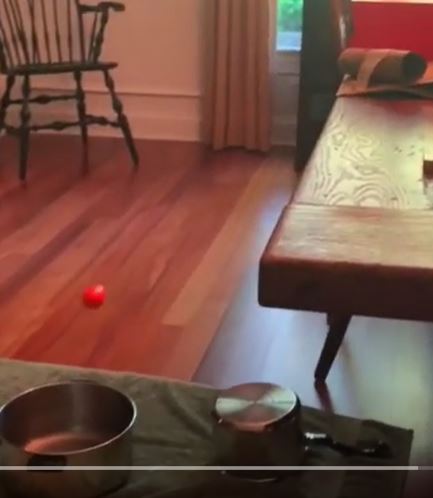


Bounce and Cascade: Attempt playing with bounces – one) the ball falls from the tabular array, bounces off 1 pot and into some other – y'all have to accept your angles just right. ii) Yous can create a "trampoline" by stretching part of a balloon over the top of the container. A common goal of Rubes is to "water a found" – basically, knock a loving cup of water over then it pours onto a plant. 3) You could roll or bounce a ball into the cup of water, or you could iv) knock over a series of domino-books to knock over the h2o.


Triggers. To get the activity started, you can 1&ii) accept something fall into a auto to push it down a ramp, 3) curlicue a ringlet of duct tape into a domino chain, or 4) take a jail cell phone vibrate its fashion down a ramp to hitting the domino concatenation.
That's simply some ideas to become you lot started. Equally you tin can see, the merely limit on Rube Goldberg design is your imagination!
More than almost Rube Goldbergs
This commodity in the Verge talks about the history of Rube Goldberg, and about modernistic RG competitions.
This video provides a cursory introduction to Rube Goldberg devices and the almanac competition, but information technology besides talks about how parents and children working together on devices provided a welcome distraction during the coronavirus lockdowns. They touch on the fact that edifice a chain reaction requires a dandy deal of patience, persistence, and the willingness to effort over again and once more to get it correct.
More resources
Here are the most helpful explanations I found for didactics kids how to build chain reactions.
- WikiHow: How to Build a Homemade RG
- Tinkerlab Build a Rube Goldberg
- Hands On As We Abound: RG to Pour Cereal
- Brain Power Family unit: Rube Goldberg Devices
- Connections University Build your own RG
- This Sesame Street video
Lesson plans for middle schoolers: https://www.teachengineering.org/activities/view/cub_simp_machines_lesson05_activity1 and https://www.teachengineering.org/lessons/view/cub_simp_machines_lesson05
Look here for more ideas for fun Contraptions activities for kids age iii – 6. That post includes recommended children's books that chronicle to contraptions or Rube Goldbergs.
Source: https://inventorsoftomorrow.com/2021/02/23/build-a-simple-rube-goldberg/

إرسال تعليق for "Easy Rube Goldberg Machine Step by Step"