Tight and Easy Money Monetary Policies Examples
What is Tight Monetary Policy?
The tight monetary policy refers to the activeness taken past the central bank to bring downwardly inflation past reducing the money demand and supply in the economy. It involves measures similar upsurging the involvement rates, selling authorities securities, and increasing the banks' reserve requirements to slow down overheated economic growth caused due to accelerating spending.
It is besides called contractionary or dear monetary policy. The prime purpose of adopting this policy is to curtail the consumers' and companies' purchasing power past increasing the borrowing cost. As the people tend to spend less on goods and services due to this policy, the need falls. It leads to a slowdown in economic inflation.
Tabular array of contents
- What is Tight Monetary Policy?
- Tight Monetary Policy Explained
- Loose vs Tight Monetary Policy
- Tools
- Examples
- Example #1
- Example #2
- Furnishings
- Advantages
- Disadvantages
- Often Asked Questions (FAQs)
- Recommended Articles
- The tight budgetary policy is a tool a nation's key bank uses to decelerate economic inflation by downsizing the coin supply in the economy.
- It emphasizes implementing the three prominent contractionary monetary measures, i.e., escalating the open market operations like selling government-issued securities, raising the discount rate, and increasing the reserve requirement.
- Such measures subtract the consumers' purchasing power, lowers consumption and product of appurtenances and services, and slow downward the economy in the long run.
- Some agin effects of monetary policy tightening include higher unemployment and a decline in the nation'due south economic growth.
Tight Budgetary Policy Explained
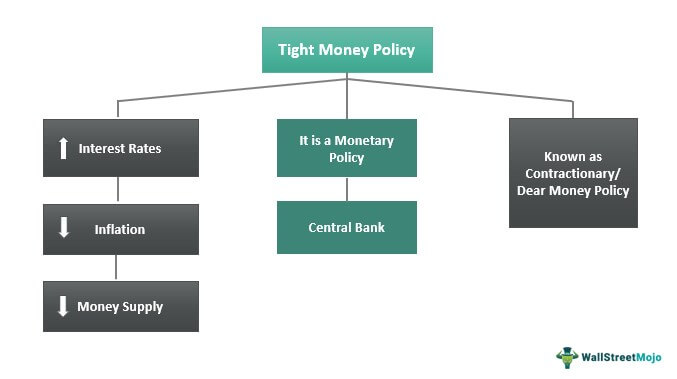
You are costless to use this image on your website, templates, etc, Please provide us with an attribution link Article Link to be Hyperlinked
For eg:
Source: Tight Budgetary Policy (wallstreetmojo.com)
The implication of tight budgetary policy is to bring down aggrandizement past limiting the circulation of coin in the economy. It makes coin more expensive to borrow by increasing short-term interest rates. Thus, a nation's key banking company takes cosmetic action to salvage the economy from slipping into hyperinflation. A high rate of aggrandizement results in ascent prices of goods and services, overvaluation of stocks, and college speculative practices as the purchasing power of money fall further.
The key bank of the Usa, the Federal Reserve Bank (Fed), regulates the money supply in the U.Southward. The coin supply refers to the full amount of money in apportionment. As money supply increases, need increases, and invariably, price increases leading to inflation. Increasing demand raises input costs and the wages of the workers. As a effect, the workers consume more. It acts like a concatenation reaction and overheats the economy.
Boosted interest rates curb money period between individuals and banks, reducing credit. Information technology absorbs extra capital from an economy. As the key banks increase their overnight interest rates, commercial banks infringe less money from them to lend information technology to the borrowers, i.e., the consumers and enterprises, as investments. Thus, money becomes more than expensive and less accessible. Information technology affects borrowings such as personal loans, interest rates on credit cards, and mortgages.
Loose vs Tight Monetary Policy
A loose or easy money policy is the opposite of a tight money policy. When deflation occurs, the growth charge per unit slows, overall consumer demand in the economy reduces, and price levels decrease. As production declines, the firms lay off their workers and terminate further investments. The foreign exports may also fall. Therefore, adopting an expansionary policy becomes essential to minimize it.
The central bank may follow an easy monetary policy to boost the country'southward economical activity. But the same bank may pursue a contractionary or tight money policy if the aggrandizement rises and the government wants to keep it under control.
Tools
The central depository financial institution of any country adopts the following three measures for the implementation of the tight monetary policy:
- Raising Discount Rates Or Short-Term Interest Rates: An increment in the rate at which the commercial banks borrow funds for the short-term from the fundamental banking company makes the loans and short-term debts expensive for these banks. Banks and then charge a higher involvement from their clients.
- Upsurging Banks' Reserve Requirement: The cardinal banking company prescribes a minimum reserve limit that the commercial banks have to keep with the former to remain eligible to role as a depository financial institution. Commercial banks are left with less working uppercase when this minimum reserve requirement increases.
- Increasing Open Market place Operations: The Federal Reserve also sells government-issued bonds and securities. It encourages people to invest or salvage more and spend less. Thus, less dispensable income is left to consumers to purchase the goods and services.
In the U.S., if the inflation charge per unit upsurges over the average rate of two%, the Federal Reserve imposes contractionary budgetary measures to attain cost stability by deteriorating the consumers' disposable income or purchasing power. However, 1 of the prime drawbacks of tightening the money supply in the economic system is rising unemployment. Information technology increases due to a refuse in the consumption and production of goods and services.
Examples
Case #i
The inflation of the 1980s is 1 of the primary tight monetary policy examples.Due to economic overheating, inflation was rising rapidly in the U.S. Information technology reached 13.50%. The unemployment charge per unit increased from 7-8% in 1980 to 10.viii% in 1982. The government used a tight money policy to reduce the inflation rate and wearisome the rising prices.
Example #2
The aggrandizement rate in the U.S. has gone upward by almost three times its average charge per unit of 2%. It is a prime concern and an alarming condition for the Federal Reserve. Thus, on May 3-iv, 2022, the Federal Reserve raised the involvement rates by one-half percent in the U.S. to bring down the price inflation across the U.South.
Although, at that place is an expected farther rise in this interest charge per unit past June and July 2022, assessing it to be between 2% to 3%. To prevent the U.S. economy from slipping into recession, the Federal Reserve would probable halt these contractionary measures by September, when the involvement rate will reach somewhere between one.75% and 2%. The Fed volition then focus on analyzing the touch of this monetary tightening on employment and inflation. However, the tight monetary policy may decrease the percentage of the U.S. Treasuries yields.
Furnishings
The contractionary monetary policy facilitates the central bank to revive an inflation-struck economy. Nevertheless, its implementation is well-planned and structured since such measures have a long-lasting and muti-dimensional touch on the economy.
The tight budgetary policy has its advantages and disadvantages. Therefore, central banks may conform their economic policies in response to the economy's demands. Given beneath are the various positive and negativetight monetary policy effects:
Advantages
- Controls Inflation: The tightening of the economic system'due south coin supply primarily aims to reduce inflation and ensure the price stability of goods and services.
- Encourages Savings And Investment: Speeding upwardly the open up market place operations by selling the government-issued bonds and securities to the public motivates them to invest in government securities and salve more money. So, bond prices that provide stock-still rates of interest decrease.
- Encourages Efficiency:Reducing export demand leads to a refuse in amass demand. Even so, information technology tin can encourage firms to produce more efficiently and cut costs as competitiveness decreases.
- Eases Implementation:A change in monetary policy is preferred over a financial policy equally legislation takes a long time to become law and implement spending adjustments.
Disadvantages
- Reduces Purchasing Ability of Consumers: As the minimum reserve requirement rises, the commercial banks take less money to offer as loans to the customers. It shrinks their purchasing power.
- Makes Short-Term Borrowings Expensive: With an increase in the discount rate, commercial banks accuse higher involvement rates on short-term loans and advances from their customers.
- Limits Consumption: Consumers with depression disposable incomes spend less on purchasing appurtenances and services.
- Decreases Production: Since the demand for goods and services falls due to the narrowing of the consumers' purchasing power, the companies have to downsize their production accordingly.
- Increases Unemployment: Every bit a outcome of low consumption, the sales of goods and services as well turn down. Thus, the companies lay off employees to cutting expenses.
- Decelerates Economic Growth: Since all the measures focus on curtailing the money circulating in the economy, there is a decrease in consumption and sales of goods and services. It results in lower profitability of the business entities. Also, the banks don't have sufficient funds to extend loans to their clients.
- Increases Exchange Rates:It leads to a decrease in exports and an increase in imports. As a event, commutation rates rising, and the balance of payments decreases.
Frequently Asked Questions (FAQs)
What does a tighter monetary policy hateful?
Thetight monetary policy meaning describes the contractionary measure adopted by the Federal Reserve to curb the aggrandizement level in the economic system. Information technology aims at limiting the money supply in the economic system to scale down the purchasing power of the consumers and firms.
How does a tight and loose monetary policy touch on interest rates?
Tight monetary policy increases the involvement rates making money more than expensive to infringe. In contrast, the loose budgetary policy reduces the interest rates making coin easily attainable for lending and borrowing.
Which ane is better expansionary or contractionary monetary policy?
Implementation of the expansionary or contractionary budgetary policy depends on the economic scenario. The function of each of these policies is different. They regulate the money supply in the economy to bring downwardly inflation or accelerate a slowed-downwards economy. And so, both these policies as help in reviving the economic system.
What is the divergence betwixt tight and easy budgetary policy?
The tight monetary policy involves the implication of contractionary measures to cut down the coin supply in the economy to control inflation. In dissimilarity, the primal bank undertakes the expansionary or easy monetary policy to pump boosted coin supply into the economy to fight the economical slowdown.
Recommended Articles
This has been a guide to Tight Monetary Policy and its definition. We explicate its implication, tools, outcome, examples, advantages, and disadvantages. Yous may acquire more from the following articles –
- Accommodative Monetary Policy
- Contractionary Monetary Policy
- Budgetary Base
Source: https://www.wallstreetmojo.com/tight-monetary-policy/

إرسال تعليق for "Tight and Easy Money Monetary Policies Examples"